
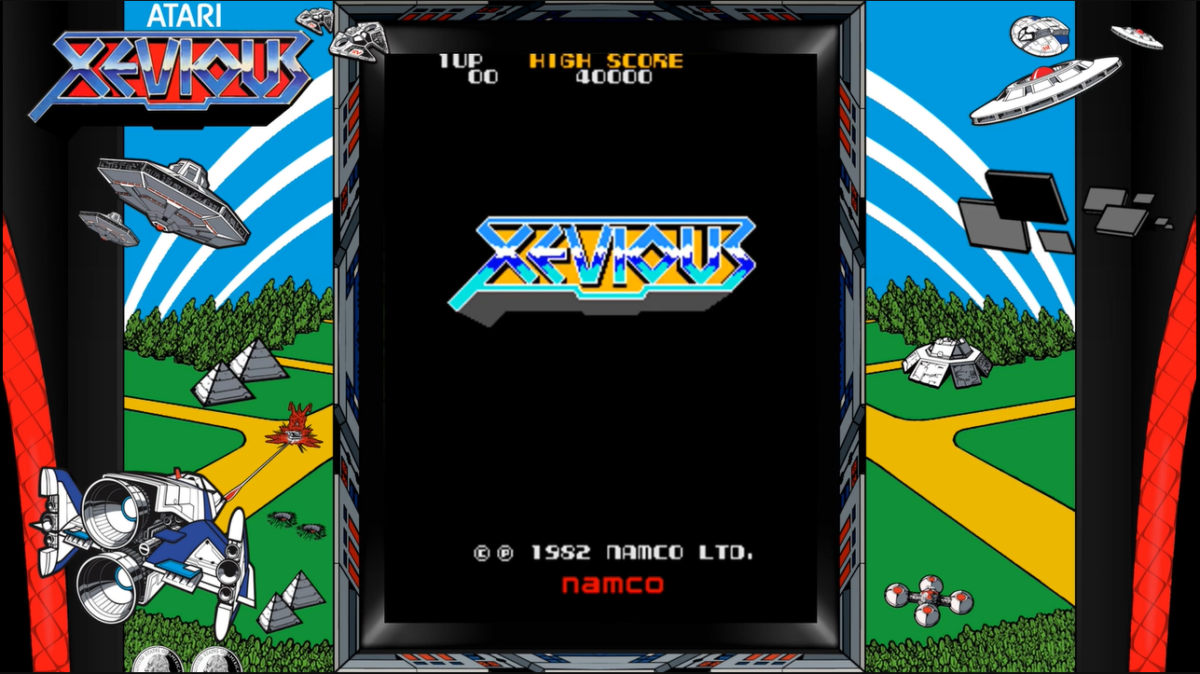
Xevious [1982]
- First boss battles
- ‘Not Space’ Backgrounds
- Very popular in JAPAN
- Dynamic Enemy Ai
ICONIC
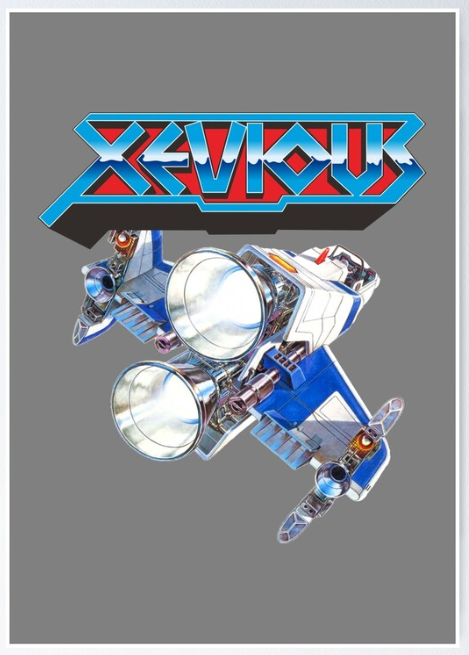
Solvalou
Andor Genesis

Solvalou
Xevious: The Pioneering Vertical Shooter That Shaped a Genre
Xevious, released by Namco in 1982 (1983 in North America via Atari), is a landmark in video game history, widely regarded as one of the first true vertical scrolling shoot ’em ups to define the genre. Developed by Masanobu Endoh, it captivated arcade-goers with its innovative mechanics, vibrant visuals, and challenging gameplay, leaving a lasting legacy that influenced countless games.
Origins and Development
Xevious emerged during the golden age of arcades, a time when games like Space Invaders and Galaga dominated. Namco sought to push boundaries, and Endoh, inspired by sci-fi and military themes, crafted a game that combined strategic depth with fast-paced action. The result was Xevious, a technical marvel for its time, utilizing the Namco Galaga hardware to deliver smooth scrolling, detailed sprites, and a memorable soundtrack by Yuriko Keino.The game’s narrative, though minimal, was intriguing: players pilot the Solvalou, a fighter craft, to liberate Earth from the alien Xevious forces. The story, expanded in later lore, involved an ancient conflict and supercomputers like GAMP (General Artificial Matrix Processor), adding a layer of mystique.
Gameplay and Mechanics
Xevious stood out for its dual-layered combat system. The Solvalou could fire air-to-air missiles at flying enemies and drop bombs on ground targets, requiring players to juggle two distinct attack strategies. A reticle guided bomb placement, a novel feature that added precision and skill to the formula. This split focus—air and ground—demanded multitasking, setting Xevious apart from simpler shooters. The game featured 16 repeating stages, with no true end, cycling through forests, deserts, and alien bases. Enemies were diverse, from spinning Bacura shields (indestructible obstacles) to the mothership Andor Genesis, an early example of a boss fight. Hidden elements, like Sol Towers (revealed by bombing specific spots), rewarded exploration, while flags (a nod to Namco’s Rally-X) offered extra lives. Difficulty scaled dynamically, with enemy aggression increasing based on player performance, ensuring a constant challenge. This adaptive design kept players engaged, though it frustrated some newcomers due to its steep learning curve.
Technical and Visual Achievements
For 1982, Xevious was a visual spectacle. Its vertical scrolling created a sense of journey, with detailed landscapes transitioning seamlessly. Sprites, though simple by today’s standards, were crisp, with enemies like the reflective Zoshi ships and towering motherships exuding personality. The game’s palette—earthy greens, browns, and metallic grays—evoked a war-torn world, while Keino’s pulsing soundtrack amplified tension.The hardware, powered by three Zilog Z80 CPUs, enabled smooth performance and complex enemy patterns, a feat that impressed developers and players alike. Xevious also introduced pre-rendered cutscenes in some versions, a rarity for arcades.
Cultural Impact and Reception
Xevious was a commercial hit, selling over 10,000 arcade units in Japan and gaining a strong following worldwide. Its addictive gameplay and replayability made it a staple in arcades. Critics praised its innovation; magazines like Computer and Video Games lauded its “strategic depth” and “stunning visuals” in 1983 reviews.The game’s influence is profound. It popularized vertical scrolling shooters, inspiring titles like Capcom’s 1942 and Toaplan’s Twin Cobra. Its dual-attack system and hidden secrets became genre staples. Xevious also pioneered dynamic difficulty, a concept later refined in games like Gradius and R-Type.Beyond arcades, Xevious saw ports to platforms like the Nintendo Famicom (1984), Atari 7800, and modern compilations like Namco Museum. The Famicom version, one of the earliest home console ports, sold over a million copies, cementing its accessibility. Spin-offs, like Super Xevious (1984) and Xevious 3D/G (1996), expanded the series, though none matched the original’s impact.
Legacy and Modern Relevance
Xevious remains a touchstone for retro gaming enthusiasts and developers. Its influence persists in modern shmups like Ikaruga and Dodonpachi, which owe their strategic depth to Xevious’ groundwork. The game’s aesthetic and mechanics have been referenced in pop culture, from anime to indie games.Today, Xevious is playable on emulators, retro consoles, and collections like the Arcade Archives. Its simplicity and challenge hold up, though its unforgiving difficulty may deter casual players. For collectors, original arcade cabinets are prized, often fetching high prices at auctions (a restored unit sold for $3,500 in 2023, per auction data).
Conclusion
Xevious is more than a game—it’s a milestone that shaped the shoot ’em up genre and showcased the arcade’s potential for innovation. Its blend of accessibility, depth, and technical prowess made it a classic, and its influence endures over four decades later. For gamers seeking a piece of history or a test of skill, piloting the Solvalou remains as thrilling as ever.